Troncones listed as one of the top surfing vacation spots in Mexico

Here's an article from the San Francisco Chronicle's SFGate.com about surfing in Mexico that lists Troncones as one of the top surfing vacation spots in Mexico.   

 Photo: Ricardo Espinosa - Reo, Mexico Tourism Board


Fishermen might have gotten there first, but decades before Cancún put Mexico at the top of the heap for sun-and-sand vacations, peripatetic surfers discovered the sublime beaches that fringe Mexico's west coast. In the 1950s, Matanchen Bay in northern Nayarit,  appears to have been the lodestar for surfers with a case of wanderlust — about as far as they could go in a creaky woody without sacrificing home, job and family for the sake of an exotic wave.

Hundreds of surf spots dotting more than 2,000 miles of tropical coastline have been conquered since then, some of them many miles from nowhere, some near small fishing villages and others the centerpiece of major cities. Lured by year-round long points, reefs and hollow beachbreaks, die-hard surfers know them all and think nothing of rattling their bones on long rutted roads and dropping a sleeping bag on any horizontal surface to surf their favored spots or try out a new one.

For the rest of us — casual surfers who enjoy traveling or travelers who think they might like to give surfing a whirl — a place with comfortable rooms, a few good restaurants and some cultural options is preferable.

TRONCONES

This once-drowsy fishing village, about a half-hour drive north of Ixtapa-Zihuatanejo, has mushroomed into a winter resort for U.S. and Canadian residents fleeing the cold. Besides a pristine coral-sand beach curling toward a picture perfect little bay, it offers small beachside accommodations, basic groceries and water, and ecotourism galore. If you need more excitement, Ixta and Zihua are close at hand.

Troncones Point, jutting out into Manzanillo Bay, is famous for its consistent left point break and suitability for novices and veterans alike. Waves have been reported over 15 feet in peak season, May through October, so it's not for beginners during those months.

A dozen other surf spots, many within walking distance, lie no more than an hour away. Suitable for all experience levels, La Saladita is an exposed reef and surfing point break ideal for longboarders. It's seemingly never-ending lefts earn it the moniker, "The Wave Machine."

Read more: SFGate.com

LAS POSADAS-MEXICO - CHRISTMAS AROUND THE WORLD

Las Posadas is a nine-day Navidad (Christmas) celebration with origins in Spain. Las Posadas are now celebrated mainly in Mexico and Guatemala. Posada is the Spanish word for "lodging", or "accommodation.” It is written in the plural because the celebration spans a period of several nights.

In Mexico, the Christmas holidays begin unofficially with the saint's day of Our Lady of Guadalupe. The festivities are in full swing with the beginning of the posadas — celebrated each evening from December 16 to 24. They are, in fact, a novenario — nine days of religious observance based on the nine months that Maria carried Jesus in her womb.

The posadas re-enact Mary and Joseph's cold and difficult journey from Nazareth to Bethlehem in search of shelter or lodging.

Traditionally, a party is held each night in a neighborhood home. At dusk, guests gather outside the house with children dressed as shepherds, angels and sometimes, Mary and Joseph. An angel leads the procession, followed by Mary and Joseph or by guests carrying their images. The adults follow, carrying lighted candles.


Every home has a nativity scene and the hosts of the Posada act as the innkeepers. The neighborhood children and adults are the pilgrims (peregrinos). The "pilgrims" sing a traditional song asking for shelter, and the hosts sing a reply. All the pilgrims carry small, lit candles in their hands. Four people carry small statues of Joseph leading a donkey, on which Mary is riding.

The head of the procession will have a candle inside a paper lamp shade. At each house, the resident responds by refusing lodging until finally the weary travelers reach the designated site for the party, where Mary and Joseph are finally recognized and allowed to enter. Once the "innkeepers" let them in, the guests come into the home and kneel around the Nativity scene to pray (typically, the Rosary). The “innkeepers” offer the “peregrinos” and their guests hot cider, fried rosette cookies known as buñuelos, steaming hot tamales and other festive foods.


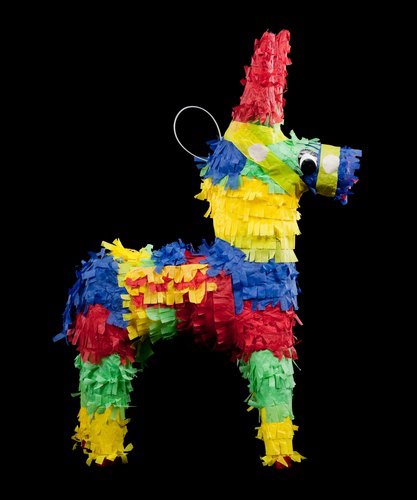
The party ends with a piñata in the shape of the Christmas star. Inside the piñata, there are cnadies, fruit and other goodies for the children.


The last posada, held on December 24, is followed by midnight mass, a tradition that lives on in countless Mexican towns and cities.

Many Latin-American countries continue to celebrate this holiday with very few changes to the tradition. In some places, the final location may be a church instead of a home. Individuals may actually play the various parts of Mary (María) and Joseph with the expectant mother riding a real donkey (burro), with attendants such as angels and shepherds acquired along the way, or the pilgrims may carry images of the holy personages instead. At the end of the long journey, there will be Christmas carols (villancicos).